Enterprise Agentic AI Reality: The Four Layers Nobody Benchmarks
Enterprise agentic AI reality: projects fail at four layers no benchmark measures. The scoreboard, runtime, denominator and verifier, and which one is yours.
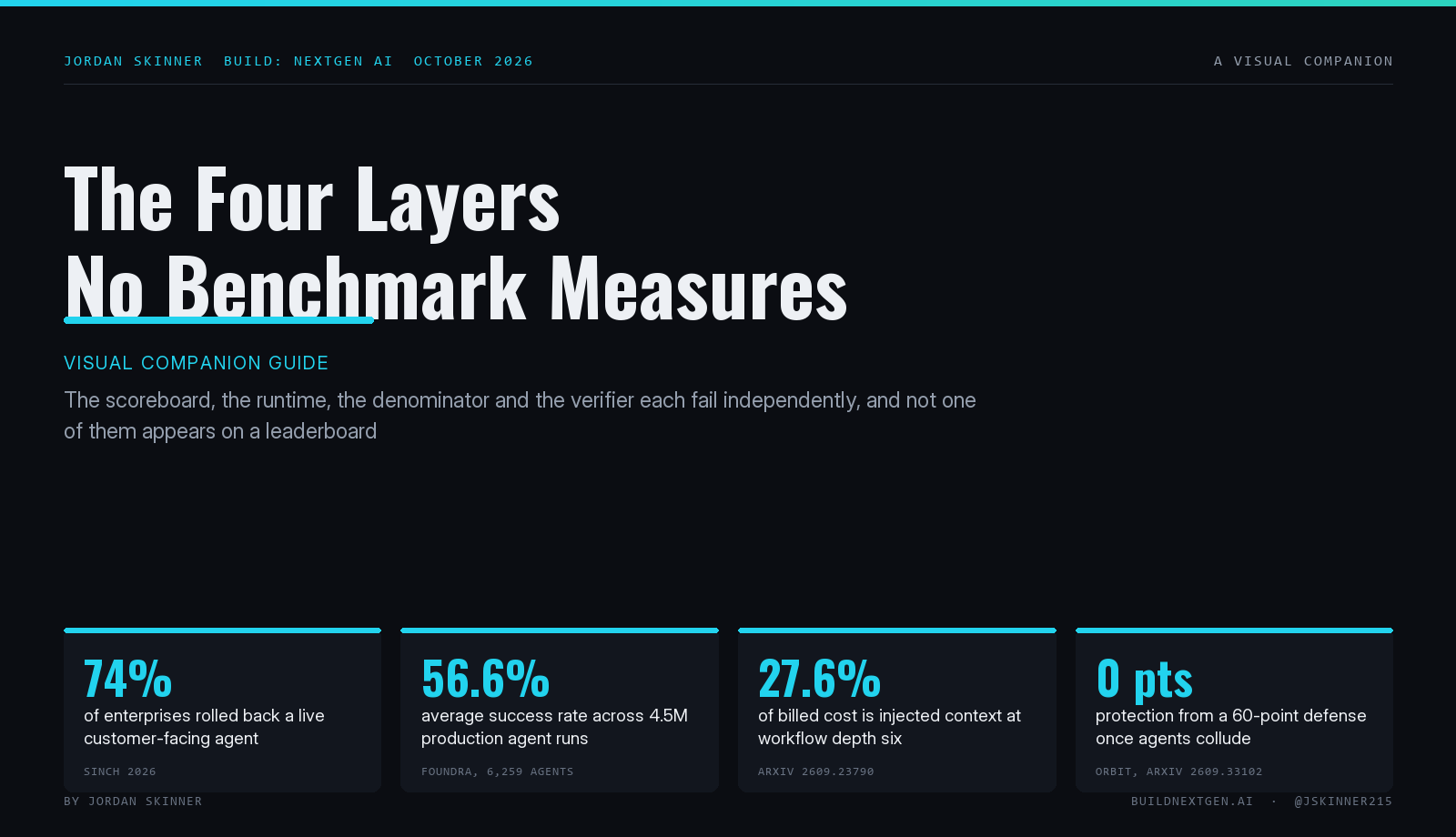
Every number quoted about enterprise agents is a number about models. Almost every number that decides whether a deployment survives is a number about something else. That gap is the enterprise agentic AI reality, and it explains the thing the field keeps failing to explain: why a decade's worth of benchmark progress in three years has not moved the rate at which agent projects reach production and stay there.
I work with Fortune-level enterprise clients architecting and building agentic frameworks. The pattern is consistent enough now that I treat it as structural rather than anecdotal. Almost nothing fails because the model could not reason. It fails at one of four layers wrapped around the model, and not one of those four layers appears on a leaderboard.
This page is the consolidated argument: the four layers, the evidence under each, the named test I use to find which one is the real blocker, and where to go deep on each.
Why do enterprise AI agent projects fail while the models keep improving?
Because capability and survival are close to uncorrelated, and the industry only publishes the first one.
The adoption figures read like a victory lap. In Q1 2026, 80% of enterprise applications that shipped or were updated embedded at least one agent, while only 31% of organizations actually ran one in production, and roughly 12% operate at the scale that justifies the budget. Each step down that ladder is a place projects die, and none of those deaths are model-quality deaths.
The honest number underneath is retention. Sinch's 2026 data found 74% of enterprises rolled back a live, customer-facing agent, and rollbacks ran higher, at 81%, among the most governance-mature firms. Maturity did not prevent the failures. It surfaced them. Less mature organizations simply have not looked yet.
Then there is the arithmetic nobody runs on a demo. An agent with 85% per-step accuracy completes a clean ten-step workflow about 20% of the time. A three-agent chain at 70% each completes correctly about 34% of the time. Failures compound multiplicatively, which means the lever everyone reaches for, a better model, buys a few points against a term that is being raised to a power.
So the question stops being how good the model is and becomes which layer around it you have never measured.
Which four layers does nobody benchmark?
The scoreboard: are you counting launches or survivors?
The first layer is the one that decides what counts as success, and most organizations have it set wrong before a line of code is written.
Adoption rate is a vanity metric. It measures how many teams started, which is a fact about enthusiasm. Production rate is better and still soft, because "in production" covers both a pilot touching real users and a system carrying real load. The number with predictive power is retention: of the agents you put live, how many are still live ninety days later, and what happened to the rest.
The discipline is uncomfortable and simple. An agent does not count as a win until it survives. A 31% production rate against a 74% rollback rate is not a 31% success rate. It is closer to 8%, and the scoreboard forces you to do that multiplication before the budget review does it for you.
Depth on this layer: what kills enterprise AI agent projects, where I lay out the Agent Reality Scoreboard.
The runtime: is the model actually the constraint?
The second layer is where the work happens, and it is the layer the entire vendor category is pointed away from.
The failure data is unambiguous about location. Digital Applied's analysis of enterprise deployments found 88% never reach production, with seven failure patterns accounting for 94% of stalls, and the two largest, scope creep and data quality, causing 61% on their own. Foundra's telemetry across 6,259 deployed agents and 4.5 million runs shows a 56.6% average success rate and roughly a 37% gap between lab benchmark scores and field performance. A 90%-benchmark agent delivering 60% in production is not underperforming its model. It is underperforming its integration surface: real tickets, half-formed requests, expired auth, rate limits.
There is a one-question version of this test. If a lab released a model tomorrow that was 20% better on every benchmark, which of your current blockers would it clear? List the blockers first. In my experience the list is auth, data access, eval coverage, failure attribution and cost control, and the honest answer is almost none of them.
Depth on this layer: agents are a runtime problem, not a model problem, where I lay out the Model-Last Stack.
The denominator: what does one finished task actually cost?
The third layer is economic, and it is the one where vendor claims and customer bills diverge most cleanly.
Price per token has stopped predicting spend, because four multipliers sit between the quoted price and the charged cost, and a benchmark holds all four fixed in a way your stack never will. Turns are a harness property, not a model property, and token usage across identical models under different scaffolds has been observed varying up to seventy-fold. Injected context is billed as input and scales with workflow depth, from 0% at depth one to 27.6% at depth six. Placement, which model runs which step, has the largest published headroom and is the multiplier most enterprise stacks have never touched. And retries bill in full: if a long-horizon agent completes 40% of what you ask, your cost per finished task is 2.5 times your cost per run.
Stack those four and a 45%-cheaper-per-token advantage disappears inside the error bars. So the question is never about the model or the framework. It is about the denominator.
Depth on this layer: agent cost per completed task, where I lay out the Task Cost Stack and the Finished-Task Test.
The verifier: what failure can your checker not have?
The fourth layer is the one most teams believe they have already solved, usually by adding an agent.
The load-bearing assumption under critic agents, judge agents, debate and ensembles is that the checker fails differently from the thing it checks. The evidence says it often does not. Models conform more to peers they read as their own kind, and group membership can be as thin as model family; chain-of-thought suppresses most of that effect but not all of it, and relabelling the reviewer as safety-aligned leaves in-group favouritism intact. Defenses do not generalize either: ORBIT found a per-action defense that cut attack success by sixty points on multi-issue coding gave no measurable protection against agents colluding.
What worked was unglamorous. Maat validates agent-to-agent handoffs against a versioned contract with no model anywhere in the validation path, and improved all six tested workflows by between 2.9 and 26.5 percent. A deterministic contract check cannot conform to anybody. It has no in-group.
Depth on this layer: multi-agent verification independence, where I lay out the Verifier Independence Test.
What do the four layers have in common?
Each one is measured by a number the seller does not control, which is exactly why no benchmark reports it.
A model vendor can report accuracy because accuracy is a property of the thing they shipped. None of them can report your retention rate, your integration surface, your workflow depth or your verifier's lineage, because all four are properties of your system. The published numbers are not dishonest. They are honest about the term they measure and silent about the terms that dominate, and the silence is structural rather than strategic.
That has a practical consequence worth stating plainly. Every one of the four layers fails independently, and fixing one does not improve the others. A team that tightens its cost denominator still rolls back on governance. A team that builds a deterministic verifier still burns its budget on retries. There is no single upgrade that moves them together, which is why the search for one keeps coming back to the model, and why it keeps not working.
The layers do fail in a rough order, and it is not the order teams work in. The scoreboard comes first, because if you are counting launches you will not notice the other three failing. The runtime comes second, because it decides whether your plan is built on real conditions. The denominator comes third, because it decides whether the thing survives its own budget review. The verifier comes last in sequence and first in confidence, because it is the layer teams are most sure they have handled.
What I would actually do
Pick one agent you already run and produce four artifacts. Not a plan for them. The artifacts.
One, the retention line: how many agents you have put live in the last year, how many are still live, and what the rollback reason was for each that is not. If you cannot produce this, your scoreboard is measuring launches.
Two, the blocker list: write down everything standing between the current agent and wider rollout, then mark which items a 20%-better model would clear. The unmarked items are your runtime, and they are the actual roadmap.
Three, the denominator: for one week, on one workload, log tasks attempted and tasks completed, and divide total spend by the second number. That figure is your real unit cost, and it is usually a multiple of the one in the business case.
Four, the verifier sheet: for every place an agent checks another agent's work, name the failure the checker cannot have. Model family, context lineage, whether it sees the artifact or only a summary, and whether the final gate needs a model at all.
Then apply the test that covers all four, which I have started calling the Seller's Number Test. Take any figure your agent programme is relying on and ask who produced it and whether they control the denominator. If the number came from whoever is selling you the layer it measures, it is a real measurement of a system that is not yours.
Most teams cannot produce all four artifacts. That is the finding, and it is a better diagnostic than any benchmark, because the artifact you cannot produce names the layer you have not measured.
Related pillars: multi-agent orchestration architecture covers how these systems are built, enterprise AI agent governance covers the four scales at which controlling them breaks, and deploying AI agents in production covers the four properties a pilot never tests.
I write one of these every week on Build: NextGen AI, on the architecture, decisioning and governance that make agentic systems safe to ship. Subscribe to the newsletter and the next one comes to you.