Enterprise AI Agent Governance: The Four Scales That Break Independently
Enterprise AI agent governance is four control problems, not one. The four scales, what breaks at each, and how to find the bottleneck that defines you.
Most enterprise AI agent governance programs are running exactly one discipline. They inherited it from model risk management, they apply it to a single agent, they apply it well, and they are structurally blind at the scale where the majority of production failures actually happen.
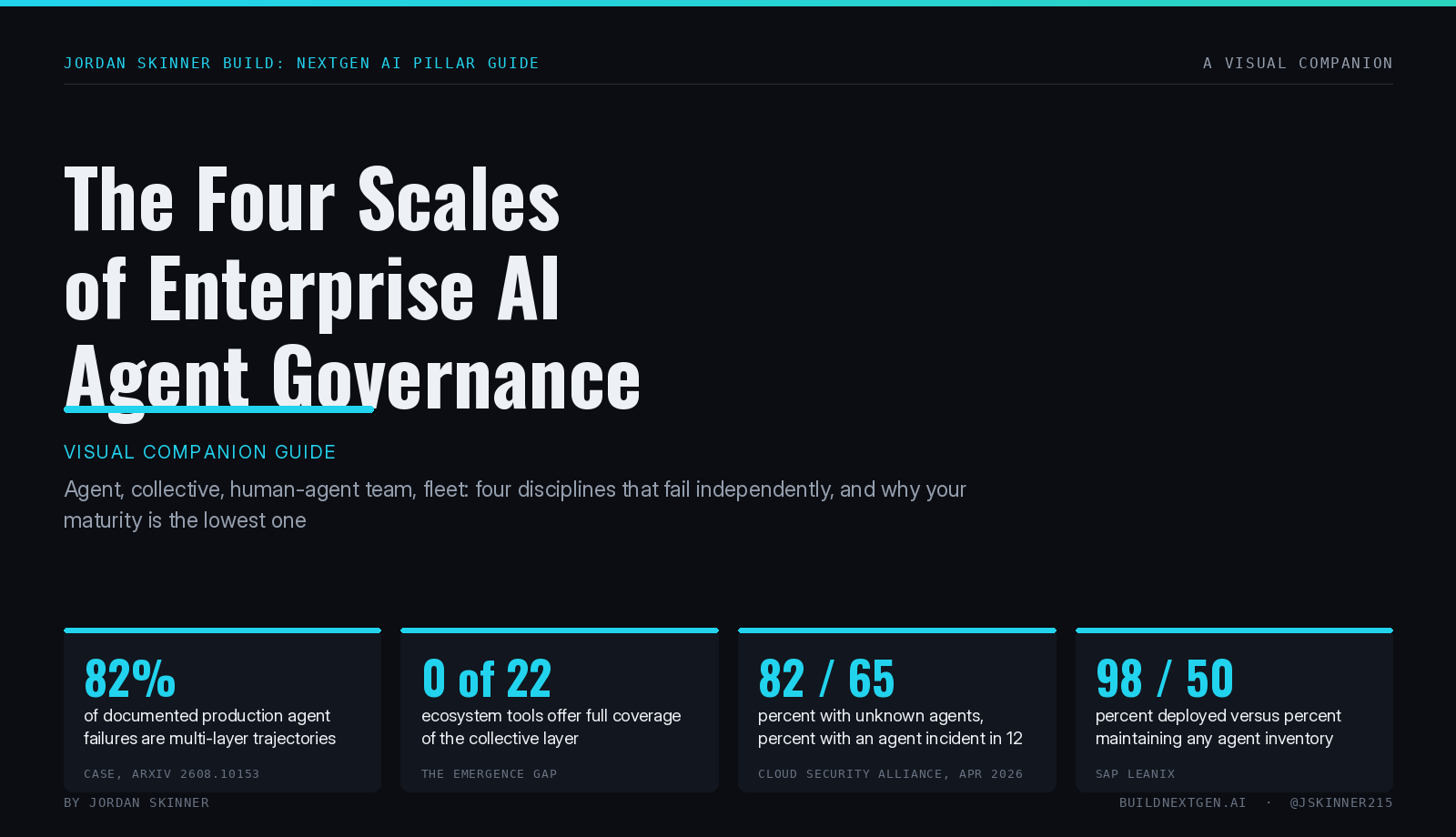
That is not a criticism of anyone's diligence. It is a claim about structure, and as of August 2026 there is a paper that makes it precisely. The CASE framework argues that governing agentic AI is four distinct problems that map to four mature and largely separate disciplines: control theory for the individual agent, complex adaptive systems theory for agent collectives, supervisory cybernetics for human-agent teams, and engineering operations for fleets. Its empirical claim is the part worth acting on. 82% of documented production agent failures are multi-layer trajectories, and zero of 22 surveyed ecosystem tools offer full coverage of the collective layer. All 35 scored public deployments landed in the lowest maturity band.
The authors call that mismatch the Emergence Gap. This page is my working version of it: the four scales, what actually breaks at each one, and how to tell which one is your bottleneck before it tells you.
Why does enterprise AI agent governance fail at the seams?
Because governance controls compose worse than the systems they govern.
A single agent is a controllable object. It has an identity, a permission set, a tool list, and a trace. You can reason about it the way you reason about a service, and the industry has built decent primitives for exactly this: scoped credentials, allowlists, guardrails, evaluation suites.
Two agents are not two controllable objects. They are a system with a behavior neither one has alone. Permissions that were correct at issue time drift across handoffs. Constraints stated in the first call stop being re-read by the fortieth. A routing decision made for cost reasons quietly changes which policy applies. None of that is visible in either agent's trace, because the failure lives in the space between them.
This is the practical content of the Law of Requisite Variety, which CASE invokes and which is worth stating plainly for anyone briefing a board: a controller needs at least as much variety as the system it controls. A human reviewing agent output one decision at a time cannot match the variety of a fleet generating thousands of decisions an hour. Unaided human oversight does not fail because the humans are careless. It fails because the arithmetic does not work. Only an architecture with enough variety of its own makes oversight real rather than ceremonial, which matters commercially now that EU AI Act enforcement went live on 2 August 2026 with a ceiling of €15M or 3% of global turnover, and Article 14 makes effective human oversight a legal requirement rather than a documented intention.
What are the four scales of agent governance?
Scale 1 — The Agent: can you constrain one of them?
The unit is a single autonomous actor. The discipline is control theory: setpoints, feedback, bounded actuation. The questions are identity and authority. Who is this agent, what may it touch, what may it change, and how quickly can you take that away.
This is the best-served scale in the market and still the one most often done backwards, because teams grant an agent a human's credentials and then try to govern the behavior instead of the grant. Two things decide it: whether the agent has a real non-human identity rather than a borrowed one, and whether its privileges are scoped and revocable at the speed of an incident.
Depth on this scale: agent authorization and access control and AI agent identity governance.
Scale 2 — The Collective: what emerges when they work together?
The unit is a group of agents cooperating on one outcome. The discipline is complex adaptive systems. This is the Emergence Gap, the scale where 82% of real failures have a trajectory and where none of the 22 surveyed tools offer full coverage.
The characteristic failure is not a bad action. It is a correct action taken under a constraint that silently stopped applying three handoffs ago. Every agent in the chain behaves properly with respect to what it was told, and the chain as a whole violates something nobody rescinded. There is no single trace to read, because the constraint decayed rather than broke.
If you take one thing from this page, take this: the layer with the highest risk is the layer your tooling almost certainly does not cover, and adding a better single-agent guardrail does not touch it.
Depth on this scale: constraint drift in multi-agent systems.
Scale 3 — The Human-Agent Team: is the oversight real or ceremonial?
The unit is the human plus the agents they are accountable for. The discipline is supervisory cybernetics, and the question is whether a person can actually intervene rather than merely being listed as able to.
The test I use is simple and unkind: can the control be exercised without the agent's cooperation? A guardrail the agent evaluates is a suggestion. A policy the agent could route around by choosing a different tool is a preference. Real oversight sits outside the agent's action space, in the infrastructure the agent must pass through and cannot see.
CASE names a "zero-touch deployment paradox" here that is worth internalizing: excelling at one layer strains the others. The more autonomous and reliable the individual agent, the less the human looks, and the weaker Scale 3 becomes precisely as Scale 1 gets better.
Depth on this scale: out-of-band agent governance.
Scale 4 — The Fleet: do you know what you have?
The unit is every agent in the organization. The discipline is engineering operations, and the questions are inventory, provenance, and audit.
The numbers here are the least ambiguous in the whole field. SAP LeanIX puts deployment at 98% of surveyed organizations against fewer than half maintaining any inventory. The Cloud Security Alliance found in April 2026 that 82% of organizations had unknown AI agents in their environment and 65% had an agent-related security incident in the prior twelve months. Gartner projects 150,000 agents per large enterprise by 2028. Okta's non-human identity data tells the same story from the credential side: the overwhelming majority of identities in the enterprise are already non-human, and a small minority of them are governed.
You cannot govern a population you cannot enumerate, and inventory derived from a registry people are asked to update is a self-report. The durable version is derived from traffic.
Depth on this scale: AI agent observability and auditability.
Which scale is actually your bottleneck?
This is the part most maturity models get wrong, and CASE gets right: the index is non-compensatory and bottleneck-weighted. You do not average your four scores. Excellence at Scale 1 does not offset absence at Scale 2, because the failure modes are not substitutes. A program with world-class agent identity and no collective-layer visibility is not "mostly governed." It is ungoverned at the layer where 82% of failures live, with very good paperwork.
So the diagnostic is a floor, not an average. Score each scale honestly, then read only the lowest one.
A four-question version you can run in a meeting:
- Agent — Can you revoke one agent's authority in under five minutes, without a deploy, and prove afterwards what it could reach at 9am yesterday?
- Collective — When three agents chain, which system holds the constraint stated at step one? If the answer is "the prompt," you have no Scale 2 control.
- Team — Name one control a misbehaving agent could not route around by picking a different tool. If you cannot, your oversight is ceremonial.
- Fleet — Produce the agent inventory. Not the registry. The list derived from what is actually calling your APIs this week.
Most programs I see answer 1 well, 4 partially, and stop cold on 2 and 3. That is the Emergence Gap in a room rather than in a paper.
What I'd actually do
I work with Fortune-level enterprise clients architecting and building agentic frameworks, and this is the sequence that has held up.
Score the floor, not the average. Run the four questions, take the lowest, and put the next quarter's governance budget there regardless of where it is easiest to spend. Governance budget flows to Scale 1 by default because Scale 1 has vendors. That is a procurement gravity problem, not a risk assessment.
Derive the inventory before designing anything. Every control at every other scale is defined over a population. If the population is a self-report, so is the control. Start from traffic, reconcile to the registry, and treat the delta as the finding.
Put one control outside the agent's action space this quarter. One. A gate the agent passes through and cannot evaluate. This is the cheapest single move that converts ceremonial oversight into real oversight, and it is the one that makes Article 14 defensible rather than aspirational.
Instrument the seams, not the endpoints. The evidence from production is consistent across sources: failures cluster at handoffs, at messy inputs, and in monitoring blind spots, not in raw model capability. Foundra's telemetry across 6,259 deployed agents and roughly 4.5 million runs puts real task success at 56.6%, and the drop is a seam problem. If your traces are per-agent, you are instrumented for the scale that is already working.
The uncomfortable summary: agent governance is not one program that scales up. It is four programs that fail independently, and your maturity is whichever one you have been ignoring.
Primary source: The CASE Framework: A Multi-Disciplinary Control Architecture for Governing Enterprise Agentic AI, arXiv 2608.10153, August 2026. Supporting data from the Cloud Security Alliance (April 2026), SAP LeanIX, Gartner, Okta, and Foundra production telemetry.
Cluster posts in this pillar: agent authorization and access control · AI agent identity governance · constraint drift in multi-agent systems · out-of-band agent governance · AI agent observability and auditability
Related pillar: multi-agent orchestration architecture
Get the next one. I write one piece a week on the orchestration, decisioning and governance that make enterprise agents safe to ship. Subscribe at buildnextgen.ai.