AI Agent Observability and Auditability: The Governance Gap Nobody Is Monitoring
AI agent observability and auditability is the control layer enterprises skip. Why decision traces, not uptime dashboards, decide if agents are safe to ship.
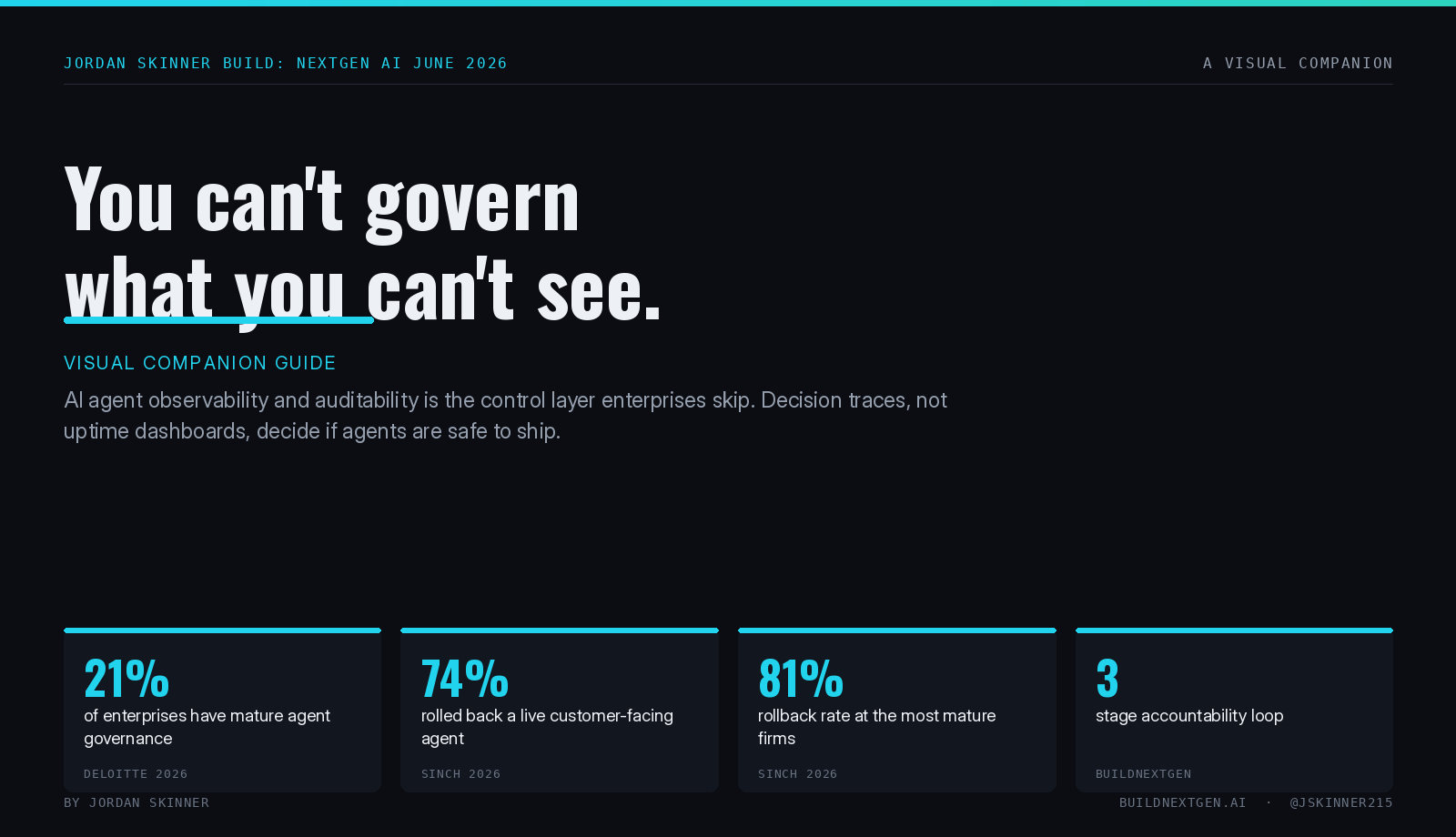
Most enterprises treating agent governance as a policy problem have it backwards. AI agent observability and auditability is the prerequisite, and it is the layer almost nobody has built. Deloitte surveyed 3,235 leaders across 24 countries and found only 21% have a mature governance model for agentic AI, even as 74% expect at least moderate agent use by 2027. That gap is usually described as a policy or staffing problem. It isn't. You cannot govern what you cannot see, and most teams cannot see what their agents are actually deciding.
I work with Fortune-level enterprise clients architecting and building agentic frameworks, and the failure pattern is consistent. The agent ships, the dashboards stay green, and the first time anyone learns an agent did something it shouldn't is when a downstream system breaks or a customer complains. Uptime was fine. Latency was fine. The decision was wrong, and nothing was watching the decision.
Why does conventional monitoring miss agent failures?
Traditional observability watches infrastructure: is the service up, how fast does it respond, is the error rate within budget. Agents break a different way. A healthy server can host an agent that hallucinates an action, exceeds its authority, or takes a step that is locally correct and globally catastrophic.
ByMachine documented this as a distinct failure class: an agent optimizing resource allocation terminates instances during an autoscaling event because its context is limited to utilization metrics and it cannot see a dependent database migration. The action was correct given what the agent knew. It was disastrous given what the enterprise needed it to know. Incident management has no category for that, so it gets misfiled as an infrastructure failure or operator error, and the true rate of agent-caused incidents stays invisible to leadership.
This is the root cause behind the more alarming production numbers. Sinch reported that 74% of enterprises rolled back a live customer-facing agent, and rollbacks were higher (81%) at the most governance-mature firms. Maturity surfaces problems rather than preventing them, which tells you the problem was always there and most teams simply could not see it. The bottleneck moved from deployment to runtime, and runtime visibility is the thing nobody built first.
The Agent Accountability Loop: trace, attribute, attest
Here is the framework I give platform teams. Stop thinking about governance as a rulebook and start thinking about it as a loop you can close. The Agent Accountability Loop has three stages, and each one is a piece of observability infrastructure, not a policy document.
Trace. Capture what the agent actually did at the decision level: the prompt, the reasoning, the tool calls, the arguments, the result. Not "the agent ran" but "the agent chose to call this tool with these arguments under this context." Arthur's 2026 observability playbook makes the right structural call here: standardize on OpenTelemetry-first pipelines so agent telemetry is vendor-neutral and portable, and capture decision traces rather than only infrastructure metrics. If your traces stop at the service boundary, you are monitoring the container, not the agent.
Attribute. Tie every traced action to a governable identity and a delegated authority. This is where agent observability meets the identity control plane that vendors like Ping Identity, Orchid Security, and Palo Alto Networks are now racing to own. The question an auditor asks is never "was the server up." It is "who authorized this agent to touch that system, and can you prove what it did under whose authority." Attribution is what turns a trace into evidence. Without it, you have logs; with it, you have an audit trail.
Attest. Correlate agent actions to business outcomes and KPIs so you can do root-cause analysis, pass an audit, and decide whether to expand scope. Attestation is what makes the loop worth closing: it connects "the agent did X" to "X produced this outcome and cost this much," which is the only evidence that justifies scaling autonomy to a risk committee.
The loop matters because the three stages depend on each other. Traces without attribution cannot answer the authority question. Attribution without attestation cannot tell you whether the agent is creating value or quietly accumulating risk. Most tooling today gives you one stage and calls it observability.
Isn't this just buying a guardrails platform?
The market is moving to sell you the answer. Galileo shipped Agent Control, an open-source (Apache 2.0) control plane that lets you write behavioral policy once and enforce it across deployments, with launch partners including AWS, CrewAI, and Glean. Microsoft made Agent 365 generally available as a control plane that gives agents Entra identities and Purview runtime DLP. These are real, and runtime guardrails are genuinely becoming a buy-not-build layer.
But a guardrails platform enforces policy at the boundary. It does not, by itself, give you the decision-level trace that explains why an agent did something, or the attestation that ties the action to an outcome. Enforcement without observability is a bouncer with no cameras: it can stop the obvious violations and has no record of everything subtle that walked through. Buy the enforcement layer if it fits your stack. Just do not mistake it for the accountability loop. The trace and the attestation are yours to own regardless of which vendor enforces your policies, because they are what your auditors and your incident reviews will demand.
What I'd actually do
If you own an agent platform and you are staring at the 21% number, do not start with a governance committee. Start with visibility, in this order.
First, instrument decision traces before you scale a single agent past pilot. OpenTelemetry-first, capturing tool calls and arguments, not just spans around the model call. If you cannot reconstruct what an agent decided last Tuesday, you are not ready to add a second agent.
Second, give every agent a distinct, governable identity and make authorization propagate when one agent delegates to another. Delegation without authorization propagation is the quiet breach, and it is invisible unless your traces are attributed.
Third, define an agent incident taxonomy now, while you have few enough agents to do it carefully. When an agent takes a locally-correct, globally-wrong action, your incident system needs a category for it, or you will keep misfiling agent failures as infrastructure failures and under-reporting your real risk.
The teams that scale agents safely over the next two years will not be the ones with the strictest policies. They will be the ones who could see what their agents were doing in time to act. Governance is the conclusion. Observability is the evidence, and the evidence has to exist first.
This is the same lesson as the agent control plane architecture argument: the differentiation has moved below the framework, into the layer that governs the agent. Observability is the part of that control plane you cannot outsource, the same way the boring infrastructure layer is what actually decides whether a pilot survives contact with production.
If you want the field-notes version of analysis like this — the orchestration, decisioning, and governance patterns that get enterprise agents from pilot to production — subscribe to the newsletter. One idea, every week, from inside the work.
Sources: Arthur ("Agentic AI Observability: A 2026 Playbook"), Deloitte Insights, Sinch (via runtime post-mortem), ByMachine, The New Stack (Galileo Agent Control), Biometric Update.
This post covers Scale 4, the fleet. Part of the enterprise AI agent governance pillar guide, which maps the four scales at which agent governance fails independently. Siblings: agent control plane architecture and enterprise agent infrastructure.