Agent Control Plane Architecture: Why the Framework Is Table Stakes and the Control Plane Is the Moat
Agent control plane architecture is the real enterprise moat. Why Vercel shipping enterprise controls on day one resets what "production-ready" means.
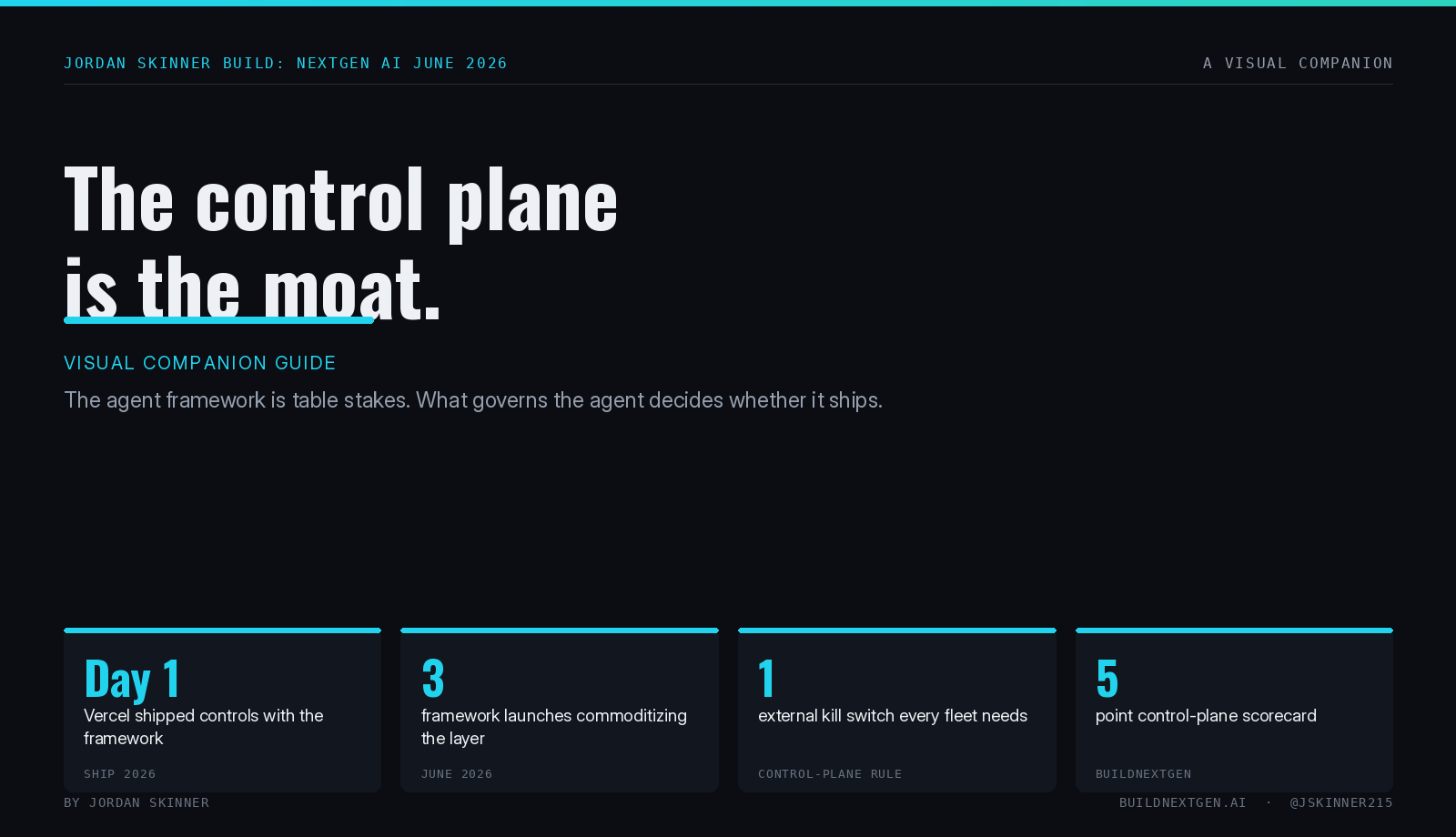
If you are choosing an agent platform in 2026, the agent control plane architecture matters more than the framework sitting on top of it. The framework writes the agent; the control plane decides whether that agent is allowed to act, can be observed while it does, and can be stopped when it goes wrong. Vercel's Ship 2026 launch made that split impossible to ignore: it shipped the eve Agent Framework and a set of enterprise controls together, on day one, rather than bolting governance on a release later.
That timing is the whole story. For two years the agent conversation was about capability: which framework, which model, which orchestration pattern. The vendors who are winning enterprise deals now are the ones who treat the framework as the easy part and the control plane as the product.
I work with Fortune-level enterprise clients architecting and building agentic frameworks, and the pattern is consistent: the demo is never what stalls. What stalls is the review that asks "who authorized this agent to touch that system, and can you prove what it did." That question is answered by the control plane, not the framework.
What is an agent control plane, and why does it decide production?
Borrow the term from networking and Kubernetes. The data plane is where the work happens: the agent reasons, calls tools, writes to systems. The control plane is the layer that governs that work: identity and authorization, policy and guardrails, secrets, observability, and the kill switch. In a single-agent demo the control plane is invisible because there is almost nothing to control. In a fleet of agents acting against production systems, the control plane is the system.
Three properties separate a real control plane from a dashboard:
It is external to the agent. Controls the agent can talk itself out of are not controls. Authorization, rate limits, and policy must live in a layer the agent cannot edit.
It is inherited, not reinvented. The control plane should plug into the identity, secrets, and observability you already run, so agent actions land in the same audit surface as everything else. (This is the same "fit, don't rebuild" lesson the cloud vendors learned the hard way.)
It is observable at the action level. Not "the agent ran," but "the agent, acting as this identity, called this tool with these arguments, under this policy, and here is the trace." Without that, you cannot debug, attribute, or pass an audit.
Why Vercel shipping controls on day one resets the baseline
Vercel's move is interesting less for the eve framework itself and more for the packaging. By launching full-stack agent capabilities with enterprise controls, Vercel reset the default expectation: enterprise controls are no longer a "platform team will add that later" item, they are part of the launch. Every competitor now gets the day-one-controls question in the next review they sit through.
Read it alongside the rest of June: Salesforce shipped Agentforce multi-agent orchestration with Atlas, Microsoft took its Agent Framework to 1.0, and the cloud vendors kept extending agent identity and secrets. The framework layer is commoditizing in public. The differentiation has moved down a level, to who owns the agent control plane architecture the agents run through.
The Day-One Control Plane: what I would actually evaluate
When a platform team asks me how to choose, I give them a control-plane scorecard, not a framework bake-off.
Identity and authorization. Does each agent get a distinct, governable identity, and does authorization propagate correctly when one agent delegates to another? Delegation without authorization propagation is the quiet breach.
Policy and the kill switch. Can you express "this agent may never do X" as enforced policy outside the agent, and can you stop a misbehaving agent fleet in one action?
Secrets and integration depth. Does it reuse your existing secrets manager, IAM, SIEM, and observability, or stand up parallel stores your auditors will flag?
Action-level observability. Can you reconstruct, after the fact, exactly what every agent did and under whose authority?
Portability. If you swap the framework or the model next quarter, does the control plane survive? It should. Pick the control plane for the decade; pick the framework for the project.
The teams that win the next two years will not be the ones with the cleverest agent. They will be the ones whose control plane let them ship a merely-good agent safely, while everyone else was still arguing about frameworks in a security review.
If you want the field-notes version of analysis like this — the orchestration, decisioning, and governance patterns that get enterprise agents from pilot to production — subscribe to the newsletter. One idea, every week, from inside the work.
Sources: Vercel (Ship 2026), Business Wire, SiliconANGLE, and Windows News.