AI Agent Identity Governance: The Next Breach Won't Need an Exploit
AI agent identity governance is the gap behind the 91%-run, 10%-governed divide. The data, the risk model, and the Passport Model to close it.
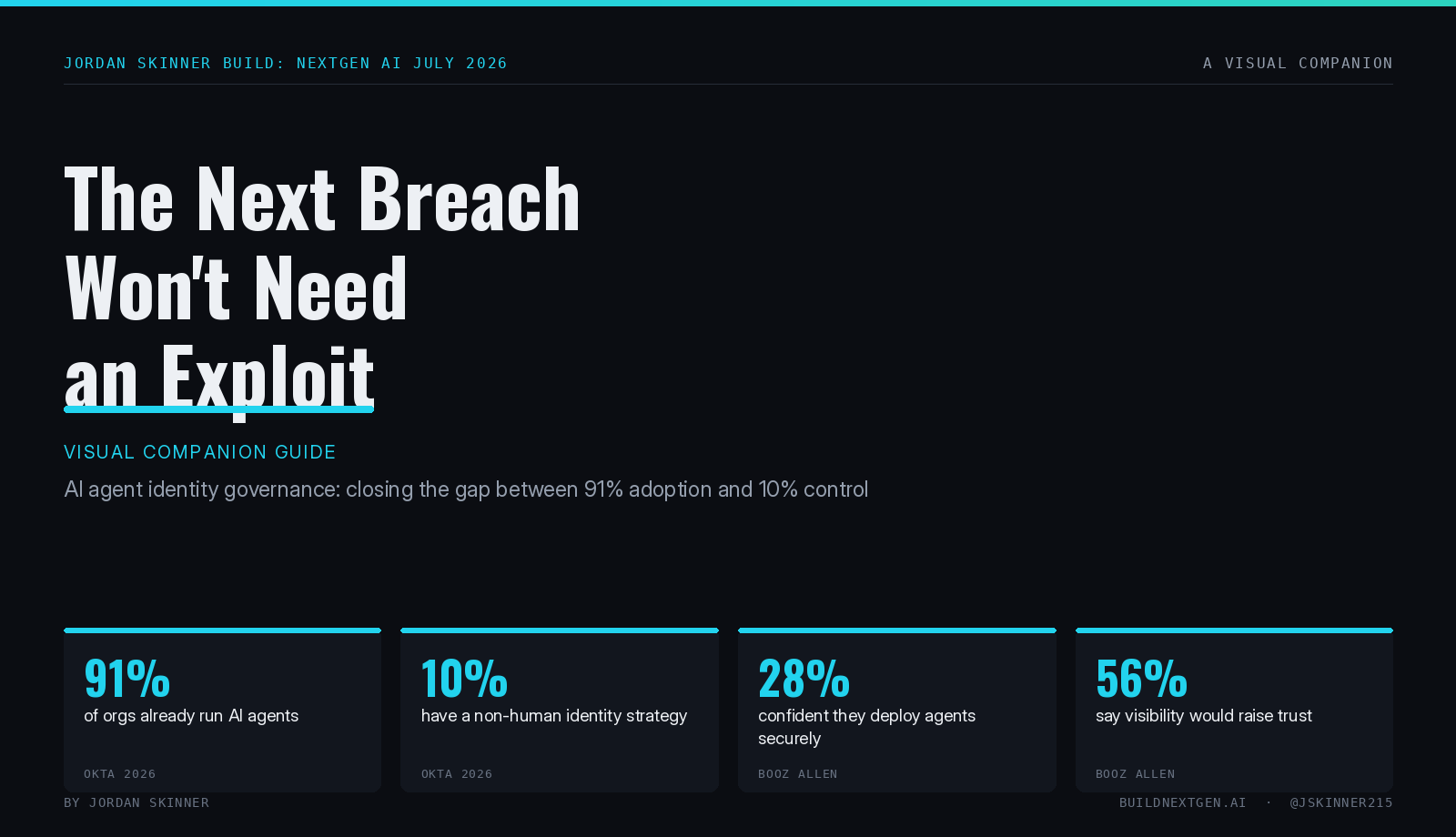
Three data points landed this week that describe the same problem from three angles. Okta's AI Agents at Work 2026 survey found 91% of organizations already run AI agents, while roughly 10% have a strategy for governing non-human identities. A Booz Allen survey of federal IT leaders found 58% of agencies deploying or piloting agents, but only 28% confident they can deploy them securely. And an OutSystems survey of 1,900 IT leaders puts centralized agent governance at 12% against near-universal adoption.
AI agent identity governance is the control layer those gaps have in common. Not model safety. Not prompt filtering. Identity: who the agent is, what it can touch, who vouched for it, and how fast you can shut it off.
Here is the uncomfortable framing. The next enterprise agent breach probably won't need an exploit. A valid login will do.
Why is agent adoption outpacing agent trust?
The adoption-confidence gap is remarkably consistent across surveys. Booz Allen's federal data shows a 30-point spread between deployment (58%) and confidence in secure deployment (28%). Okta's global data shows executives assuming controlled agent use while employees wire agents into systems no one inventoried. OutSystems finds 96% running agents in production and 12% able to govern them centrally.
The gap exists because enterprises staffed agents like employees and credentialed them like cron jobs. An employee gets an identity on day one: an account, scoped access, a manager, a badge that expires, an offboarding checklist. An agent typically gets an API key pasted into a config file. The key is long-lived, broadly scoped, rarely rotated, and invisible to the identity team.
That was survivable when the non-human population was a handful of service accounts running batch jobs. It is not survivable when agents authenticate to production systems, chain tools, and execute multi-step workflows at machine speed. When asked what would raise their confidence, 56% of the Booz Allen respondents said visibility into agent behavior, ahead of any specific control. You cannot see what you never issued an identity to.
What makes a non-human identity riskier than a human one?
BeyondTrust's framing is the sharpest I've seen this cycle: the new insider has no pulse. The risk profile differs from human insiders in four ways.
First, agents hold standing privilege. The OWASP Non-Human Identity Top 10 ranks improper offboarding and secret leakage above every exotic model attack. The risks are hygiene failures, not novel AI failures, inherited from a decade of unmanaged service accounts and amplified by autonomy.
Second, credential theft is silent. Steal an agent's token and you inherit everything the agent can reach, with no break-in to detect. No phishing artifact, no malware signature, no impossible-travel alert. SANS is convening AWS, Google Cloud, Microsoft, and Anthropic in August around exactly this scenario, because detection pipelines were built to catch human attackers, and quarterly access reviews cannot keep pace with agents making thousands of decisions per minute.
Third, prompt injection converts to privilege escalation. On a chatbot, injection is an embarrassment. On an agent holding a broadly scoped credential, injection is an attacker operating your infrastructure with legitimate access. The blast radius of a jailbreak is set by the credential, not the model. That makes identity scoping a more decisive control than model choice.
Fourth, nobody offboards an agent. Teams retire pilots, swap frameworks, kill workflows, and the credentials survive. An orphaned agent identity with standing privilege is a breach waiting for a finder.
What does AI agent identity governance actually require?
I use a four-part test I call the Passport Model. It borrows from how border control treats a traveler, because that is the right posture toward an autonomous actor entering your systems.
Passport. Every agent gets a first-class, verifiable identity: distinct from its creator's, registered, attestable, and continuously validated. Shared credentials and inherited human accounts fail this test. The ecosystem is converging here, from cryptographic agent identity in Google's Gemini Enterprise platform to Vint Cerf's DNSid proposal for anchoring agent identity to domain infrastructure.
Visa. Privilege is scoped, purpose-bound, and time-boxed. Just-in-time credentials issued for the task, expiring with it. No standing access, no wildcard scopes. This is the identity-layer complement to the runtime authorization gates I covered in agent authorization and access control: the visa decides what an agent may hold, the gates decide what it may do with it.
Ledger. Every session is attributable: which agent, which delegation chain, which human principal, which actions. Session-level accountability is what turns an incident into an investigation instead of a mystery. It builds directly on the tracing groundwork in AI agent observability and auditability.
Exit. Revocation works instantly and completely. A kill switch that actually kills: sessions terminated, tokens invalidated, delegations cancelled. If offboarding an agent takes a ticket queue and three days, you do not have an exit, you have a liability schedule.
Most enterprises I encounter pass at most one of the four. The 10% figure in Okta's data says that honestly.
What I'd actually do
I work with Fortune-level enterprise clients architecting and building agentic frameworks, and identity is where I now start, before orchestration, before model selection. The sequence that works:
- Inventory first. Discover every non-human identity that exists today, including keys in config files, tokens in CI, and service accounts nobody owns. You will find more than you expect, and the unowned ones are your risk register.
- Apply the Passport Model to your highest-privilege agent. One agent, four tests. Passport, visa, ledger, exit. The failures you find generalize to the fleet.
- Kill standing privilege on new deployments. Make just-in-time, scoped credentials the paved road for every new agent, so the debt stops growing while you remediate the stock.
- Prove the exit. Run a revocation drill the way you run a restore drill. If you have never revoked an agent end-to-end, assume you cannot.
The vendors are moving: identity providers are extending IAM to agents, and compliance tooling is going out-of-band. But buying a governance product is not governing. The operating model, the inventory, the offboarding discipline, and the drills are yours to build.
The enterprises that get this right won't be the ones with the best models. They'll be the ones where every agent can answer four questions: who are you, what may you hold, who vouched for you, and how do we make you stop.
If this framing is useful, the newsletter goes deeper on one enterprise agentic-AI decision like this every week: buildnextgen.ai.
This post covers Scale 1, the individual agent. Part of the enterprise AI agent governance pillar guide, which maps the four scales at which agent governance fails independently.