Multi-Agent Orchestration Architecture: The Guide the Frameworks Won't Give You
Multi-agent orchestration architecture, explained by a practitioner: control planes, MCP state, harness selection, portability, and managed-runtime tradeoffs.
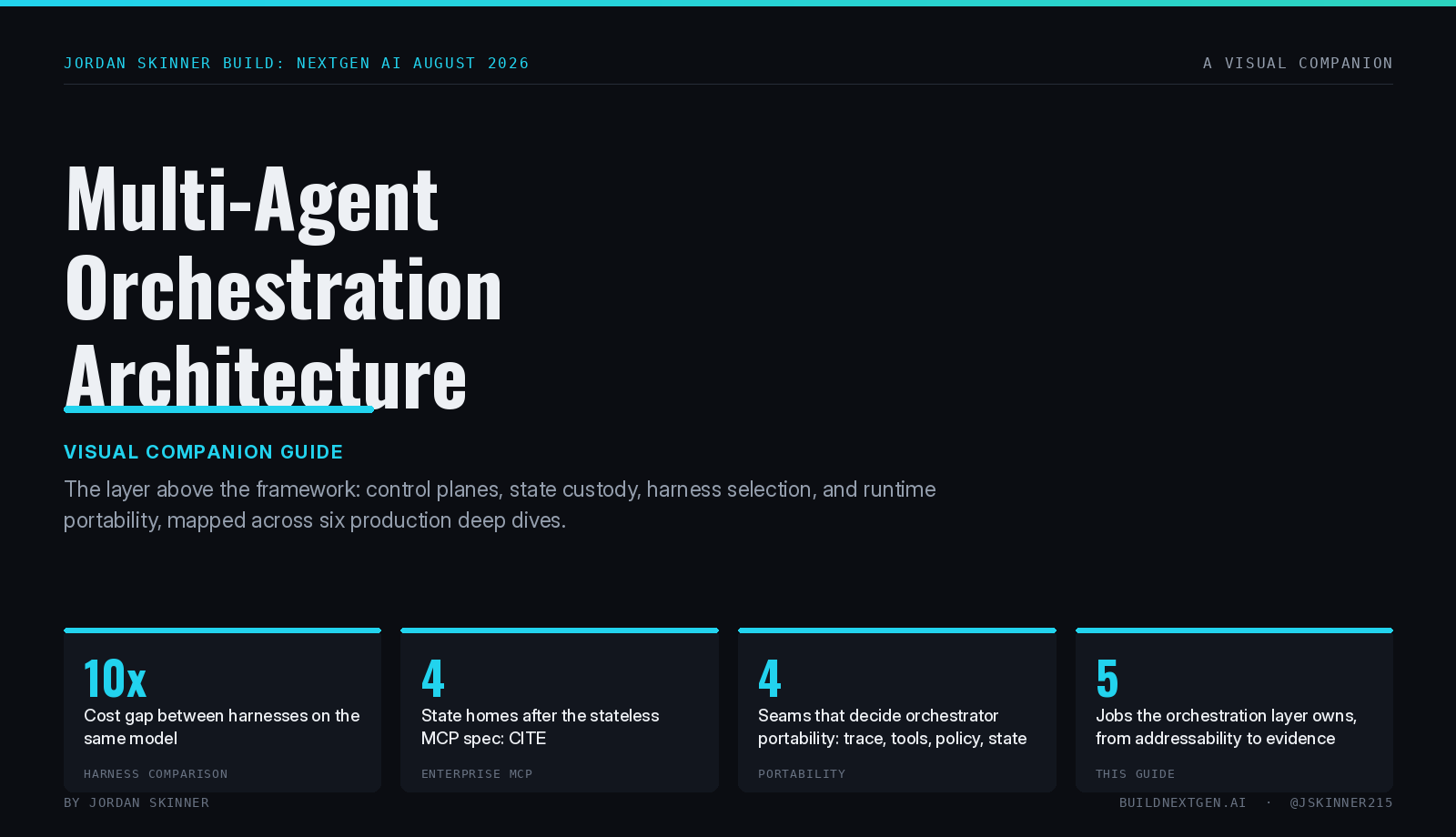
Multi-agent orchestration architecture is the discipline of making several AI agents do coordinated work you can trust, inspect, and afford. It is not a framework choice. The frameworks converged months ago; the differentiation lives in the layer above them, in how you address agents, route context, hold state, govern tool calls, and prove what happened. I work with Fortune-level enterprise clients architecting and building agentic frameworks, and every hard problem I have seen in production traces back to a decision in this layer, not to the model and not to the framework.
This page is the map. Each section compresses one production question and links to a deep dive that earns its own answer.
What actually is the orchestration layer?
Strip away vendor language and the orchestration layer does five jobs:
- Addressability. Every agent is a known, callable entity with an identity, not an anonymous loop inside a process.
- Context routing. The right slice of state reaches the right agent at the right step, and nothing more.
- State custody. Sessions, memory, budgets, and intermediate artifacts live somewhere deliberate, with an owner and an eviction policy.
- Governed execution. Tool calls pass through policy, not around it.
- Evidence. Every decision leaves a trace that survives the session that produced it.
If your architecture has a confident answer for all five, the framework running underneath barely matters. That claim sounds contrarian until you price out what the alternatives cost you in incidents.
Why is the framework table stakes?
The control plane, not the framework, decides whether a multi-agent system survives contact with production. In Agent Control Plane Architecture: The Framework Is Table Stakes, I make the argument in full: LangGraph, CrewAI, AutoGen, and the rest have converged on near-identical orchestration primitives, while the operational questions that get systems cancelled sit above all of them. Who can invoke this agent? What budget does it burn? Which tools is it allowed to reach, and who signed off? A control plane answers those questions once, for every framework you will ever run. Teams that skip it end up rebuilding it accidentally, one incident post-mortem at a time.
What does the stateless MCP spec change about state?
More than most teams have priced in. The MCP stateless spec removed the assumption that a server remembers you between calls, which means every piece of session state your agents were quietly leaning on now needs a declared home. In Enterprise MCP Architecture After the Stateless Spec I break the problem into the CITE model, four homes your agent state needs now: Connection state, Identity state, Task state, and Evidence state. Each has a different owner, lifetime, and audit posture, and conflating them is how you end up with credentials living in a scratchpad.
The migration side has its own trap, which I call session debt: the accumulated identity, scope, budget, and trail assumptions your agents made while the transport was doing the remembering. Stateless MCP Migration for Enterprise: The Session Debt Nobody Priced walks the four evictions and what each one costs to repay deliberately instead of during an outage.
How do you avoid locking yourself into an orchestrator?
Ask where your system would tear if you had to move it. In Agent Control Plane Portability: The Lock-In Hiding Inside the Consensus, I map the four seams that decide portability: Trace (does your evidence format survive an orchestrator swap?), Tools (are integrations bound to the platform or to a protocol?), Policy (is governance expressed as portable rules or as vendor console clicks?), and State (can your sessions be exported in a form another runtime can hydrate?). The uncomfortable finding: the industry consensus stack scores worst on exactly the seams that matter most, because consensus is how lock-in hides.
A fast practical test from the managed-runtime analysis below: the Export Test. Ask the vendor to show you the artifact you would carry out the door. If the answer is a config file that only their runtime can read, you do not have portability, you have permission.
Does the harness matter more than the model?
On cost, usually yes. Agent Harness Comparison: The 10x Cost Gap Lives in the Harness, Not the Model works through public benchmark data showing order-of-magnitude cost differences between harnesses running the same model on the same tasks. The Four Dials that explain the gap: Sight (what the agent gets to see per step), Scope (how much it may attempt per invocation), Recovery (what happens after a failed step), and Proof (what it must emit to be believed). Tune those four and a mid-tier model in a good harness beats a frontier model in a lazy one, at a fraction of the spend. Benchmarks that ignore harness sensitivity are measuring the scaffolding as much as the model, which is why harness choice belongs in your architecture review, not your procurement afterthoughts.
Should you buy a managed agent runtime or run your own?
Frame it as a custody question, not a convenience question. Managed Agent Runtime vs Self-Hosted: The Four Handoffs You Are Actually Signing names what a managed runtime actually takes off your hands: the Loop (who owns the execution cycle and its step limits), Memory (who holds session and long-term state), Identity (whose credential model your agents inherit), and Evidence (whose logs count when something goes wrong). Managed runtimes are genuinely good at the first handoff and quietly expensive at the last three. The architecture answer is rarely all-or-nothing; it is knowing which handoffs you can afford to sign and which ones your regulator, or your future self, will want back.
How do the pieces fit together?
A reference shape that has held up across engagements:
- One control plane, framework-agnostic, owning addressability, policy, and budgets.
- Declared state homes per the CITE model, with eviction rules written down before the first agent ships.
- A harness chosen on the Four Dials, benchmarked on your tasks, not the leaderboard's.
- Portability audited on the four seams before signing anything managed, with the Export Test applied literally.
- Evidence as a first-class output: traces, tool-call ledgers, and decisions stored where an orchestrator swap cannot orphan them.
Notice what is absent: a model recommendation. Models rotate quarterly. Orchestration architecture is the part you keep.
What I'd actually do
If you are starting this quarter: stand up the thinnest control plane that can say no to a tool call, declare your four state homes on one page, and run your top workflow through two harnesses before you commit to either. If you are already in production: run the Export Test on your runtime, price your session debt before the next MCP spec revision does it for you, and move one workflow's evidence out of the orchestrator's database as a portability drill. None of this requires a platform purchase. All of it requires deciding you own the layer above the framework.
For ongoing breakdowns of what holds up in production and what only holds up in demos, the weekly pieces land here first: buildnextgen.ai/blog.
Cluster posts under this pillar: Control Plane Architecture · Enterprise MCP After the Stateless Spec · Control Plane Portability · Agent Harness Comparison · Stateless MCP Migration · Managed Runtime vs Self-Hosted