What Kills Enterprise AI Agent Projects: Your Adoption Numbers Are Measuring the Wrong Thing
What kills enterprise AI agent projects isn't the model. 80%% of apps embed agents; only 31%% reach production. The number that predicts ROI, and how to track it.
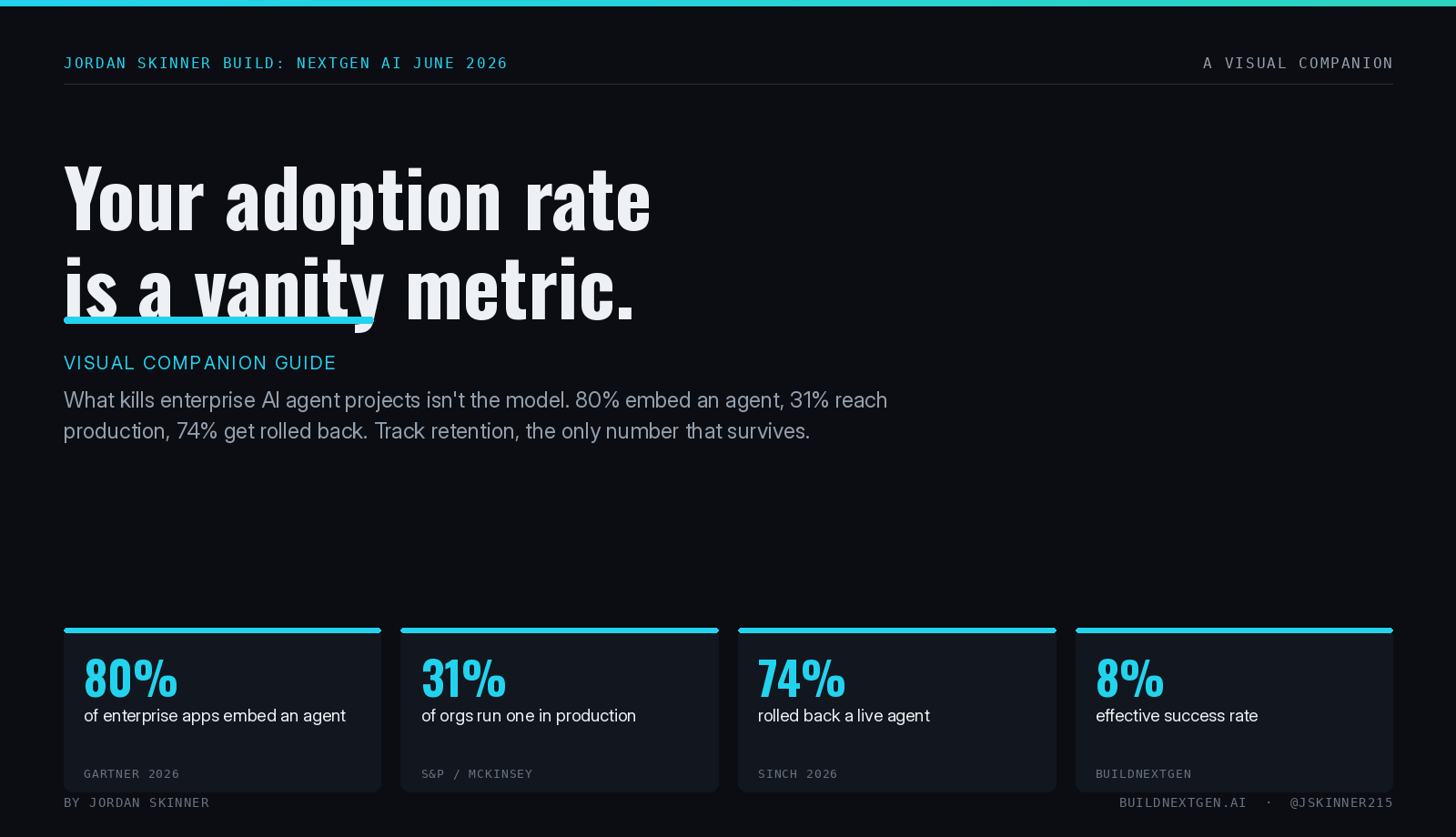
The headline numbers on enterprise agentic AI look like a victory lap. They are mostly theater. If you want to know what kills enterprise AI agent projects, stop reading the adoption charts and start reading the rollback rate. In Q1 2026, 80% of enterprise apps that shipped or were updated embedded at least one agent (Gartner). Only 31% of organizations actually run one in production (S&P Global/McKinsey). That 49-point gap is not a rounding error. It is where most enterprise AI spend, and most of the quiet write-offs, are landing this year.
I work with Fortune-level enterprise clients architecting and building agentic frameworks, and the pattern is consistent: the boardroom celebrates the embed rate, the platform team reports the production rate, and nobody owns the number that actually predicts whether the investment survives. That number is retention.
Why the adoption rate is a vanity metric
An "embedded" agent is a vendor checkbox. Your CRM shipped an agent, your ticketing tool shipped an agent, your IDE shipped an agent. Counting those tells you what your software vendors did, not what your enterprise can operate. It is the agentic equivalent of counting how many apps have a chat box.
"In production" is a better number, but it is still soft. There is a meaningful difference between running a pilot that reaches real users and running at scale. Composio's 2025 report and parallel analysis from AI Assembly Lines both land near the same figure: only ~12% of agent initiatives scale to production. So you have roughly 80% embedding, ~31% with something live, and ~12% operating at the scale that justifies the budget. Each step down that ladder is a place where projects die.
The drop-off is not a capability problem. The models are good enough. Gartner is already projecting that 40% of agentic AI projects will be cancelled by 2027, and the reason is not that the LLM got dumber. It is that the systems engineering around the model, the runtime, the permissions, and the cost controls were never built.
What actually kills enterprise AI agent projects?
The most honest number in this whole space is a rollback rate, and it is brutal. Sinch's 2026 data found that 74% of enterprises rolled back a live, customer-facing AI agent. The detail that should stop you cold: rollbacks were higher, at 81%, among the most governance-mature firms. Maturity did not prevent the failures. It surfaced them. The less mature organizations simply have not looked yet.
When you do the post-mortems, the failure modes are operational, not intellectual:
The agent loses state mid-task and acts on a stale view of the world. Its blast radius is unbounded, so a locally correct decision becomes a globally wrong one. Its cost loops are uncapped, so a retry storm turns a $0.01 task into a budget incident. None of these are model-quality problems. They are runtime problems. This is the same conclusion that shows up when you trace why demo-perfect agents collapse on real data: compounding error alone is fatal. An agent with 85% per-step accuracy completes a clean 10-step workflow only about 20% of the time.
There is one more killer hiding in the optimism. Deloitte's 2026 survey of 3,235 leaders found that only 21% of organizations have a mature governance model for agentic AI, even as 74% expect at least moderate agent use by 2027. Adoption is outpacing the guardrails that keep adoption alive. That is the structural trap: the conditions that let you ship fast are the same conditions that get the agent rolled back.
The Agent Reality Scoreboard
Here is the framework I give clients to replace the vanity dashboard. Track three numbers, in order, and refuse to celebrate the first one.
1. Embed rate (the vanity number). How many of your applications have an agent capability available? Useful only as a denominator. Never report it to leadership as progress.
2. Production rate (the reported number). How many agents are live and reaching real users or real systems? This is what most teams call success. Treat it as the start of the measurement, not the end.
3. Retention rate (the truth). Of the agents you put into production, how many are still running 90 days later without a rollback, a scope rollback, or a quiet demotion to "suggestion-only" mode? This is the only number on the board that correlates with ROI, because it is the only one that prices in everything that breaks after launch.
The discipline is simple and uncomfortable: an agent does not count as a win until it survives. A 31% production rate with a 74% rollback rate is not a 31% success rate. It is closer to 8%. The scoreboard forces you to do that math before the budget review does it for you.
What I'd actually do
If you own an agent platform or an AI P&L, three moves change the trajectory before the cancellation wave hits in 2027.
First, instrument retention from day one. Define what a rollback is for your org, log it as a first-class event, and report retention next to production rate every month. You cannot manage the number you refuse to name. If your most governance-mature peers are rolling back 81% of the time, assume you will too, and build the telemetry to catch it early instead of in an incident review.
Second, treat the runtime as the product, not the model. Scope every agent's permissions tightly, cap spend per run, and put state and observability in place before you scale past the pilot. The 49-point embed-to-production gap closes with plumbing, not prompts. This is the same argument I made about the boring infrastructure layer enterprises keep skipping, and the rollback data is now the receipt.
Third, make governance a measured loop, not a policy PDF. You cannot retain what you cannot see, which is why decision-level observability and auditability is the prerequisite for any honest retention number. Governance maturity that only surfaces failures is half a system. Pair it with the controls to act on what it surfaces.
The agentic hype cycle has peaked. The enterprises that win the next 18 months will not be the ones with the highest embed rate. They will be the ones who measured retention early, priced in the rollback, and built the runtime that lets agents survive contact with production. The adoption numbers were always measuring the wrong thing. Measure the one that survives.
Part of the enterprise agentic AI reality pillar guide, which maps the four layers no benchmark measures: the scoreboard, the runtime, the denominator and the verifier.
If you're working through the pilot-to-production gap in enterprise agentic AI, I write a weekly breakdown of the architecture, governance, and operating decisions that decide whether agents ship. Subscribe to the newsletter for the next one.
Lead data: Digital Applied, "AI Agent Adoption 2026: 120+ Enterprise Data Points". Additional sources: Sinch 2026 (rollback rate), Deloitte Insights 2026 (governance maturity), Gartner (project cancellation), Composio 2025 (scale rate).