Enterprise AI Agents Are a Runtime Problem, Not a Model Problem
Enterprise agents fail as a runtime problem, not a model problem. The failure data, Anthropic's $1.5B implementation bet, and a Model-Last build order.
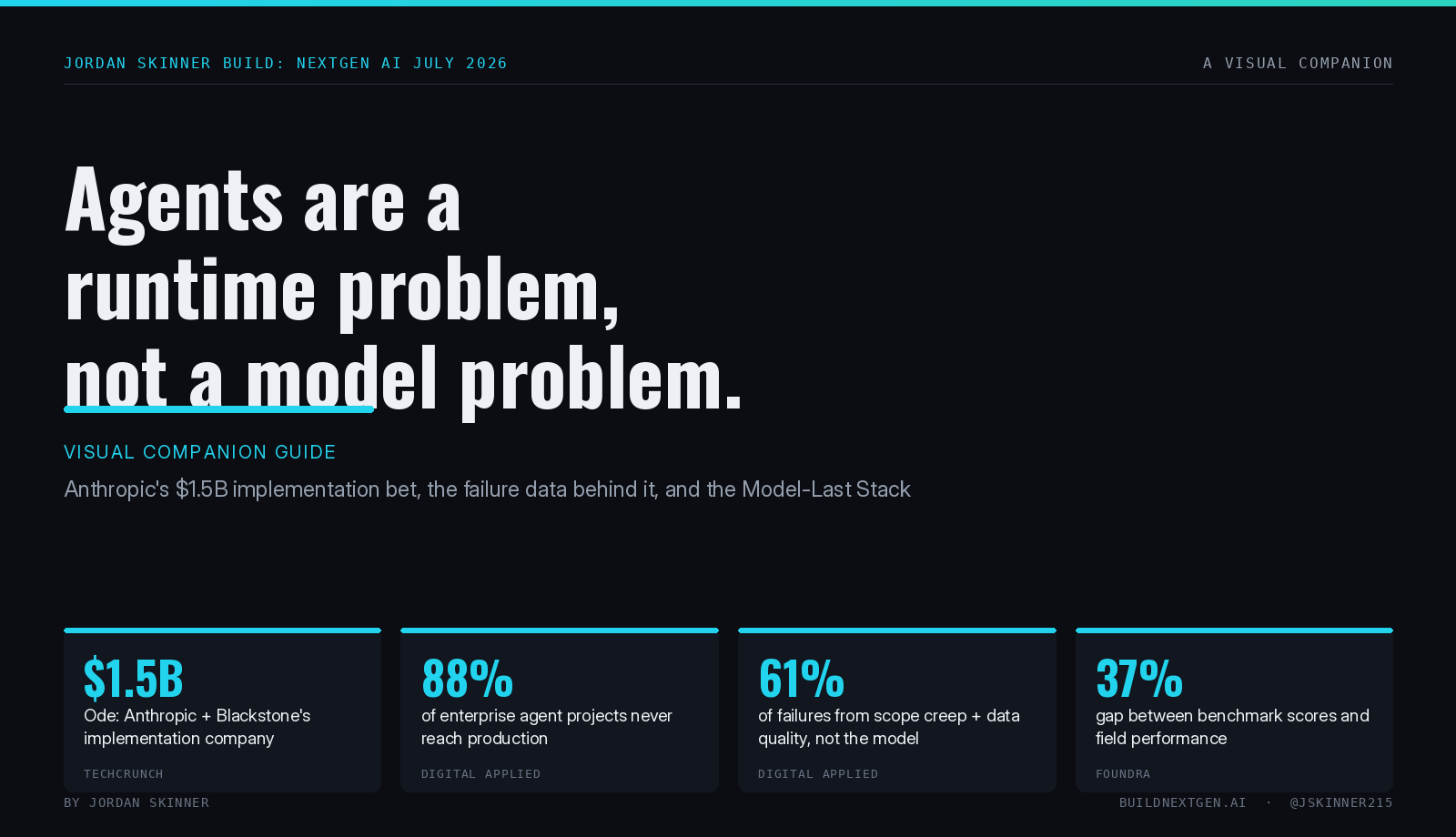
Anthropic just made the strongest argument I've seen that the agent runtime problem, not a model problem, is what separates enterprise pilots from production systems. It didn't publish the argument. It funded it. This week Anthropic and Blackstone launched Ode, a $1.5 billion AI implementation company that embeds forward-deployed engineers inside enterprises to rewire core business processes around agents. OpenAI already runs the same play with The Deployment Company.
Read that plainly: these are the two labs with the most to gain if a better model were the answer, and both are betting a billion-dollar category on the claim that the model is not the bottleneck. Ode's executives compare model selection to choosing Python or Java: a preference, not a strategy. The engineering around the model is the product.
I work with Fortune-level enterprise clients architecting and building agentic frameworks, and this matches what I see weekly: nobody's agent program is stuck because the model can't reason well enough. It's stuck in the layers around the model.
What did the Ode launch actually signal?
Three things, and none of them are about model quality.
First, the economics. Blackstone, Hellman & Friedman, and Goldman Sachs don't fund services companies at $1.5B because they expect model APIs to capture enterprise value. They fund them because the value sits in implementation, and implementation doesn't scale like software. Ode employs roughly 100 elite generalist engineers, over half former founders, and demand for those teams already outstrips supply.
Second, the posture. Ode is "Claude-first" but model-agnostic. When the vendor's own implementation arm treats the vendor's model as swappable, the swappability of models is no longer a contrarian claim. It's the operating assumption of the people closest to the deployments.
Third, the competitive set. Ode isn't competing with model labs. It's competing with Deloitte and Accenture, both of which are building forward-deployed engineering practices. The fight for enterprise agentic AI is now a fight between engineering organizations, not between model checkpoints.
What does the failure data say actually breaks agents?
If the model were the bottleneck, failure data would point at reasoning quality. It doesn't.
Digital Applied analyzed enterprise agent deployments across 2024–2025 and found 88% never reach production. Seven identifiable failure patterns account for 94% of stalls, and the two biggest, scope creep and data-quality issues, cause 61% of failures on their own. Neither is a model property. The average failed project burns about $340K before abandonment, most of it in the last 30% of the timeline, which is exactly where integration and reliability work lives.
Fiddler's production analysis puts agent project failure at 70–95% and traces the mechanics: failures compound multiplicatively. A three-agent chain where each agent succeeds 70% of the time completes correctly about 34% of the time. A 60% single-run success rate can fall to 25% across eight consecutive runs. Those are orchestration and consistency failures. Swapping the model moves them a few points; redesigning the runtime moves them structurally.
Foundra's data across 6,259 deployed agents and 4.5 million runs shows a 56.6% average success rate and roughly a 37% gap between lab benchmark scores and field performance. A 90% benchmark agent delivering ~60% in production is not underperforming its model. It's underperforming its integration surface: real tickets, half-formed requests, expired auth, rate limits.
Same conclusion from three independent datasets: agents fail in the runtime and the plumbing, not in the weights.
Where is the platform investment actually going?
Follow the roadmaps. Microsoft shipped Agent Framework for Go into public preview this week, joining Google's ADK for Go. What's in it is telling: graph-based workflow orchestration, conditional routing, checkpointing, human-in-the-loop, OpenTelemetry tracing. Runtime machinery. Not one of those features makes the model smarter. Every one of them makes the system around the model survivable in production.
The language choice is its own signal. Go is the lingua franca of cloud infrastructure. First-party Go SDKs mean agents embedded in existing microservices and infra tooling rather than bolted-on Python sidecars. The platform vendors are building for the world where agents are production services, and production services live or die on their runtime.
This connects to what kills enterprise AI agent projects: the graveyard is full of pilots with excellent models and no production engineering.
What is the Model-Last Stack?
Here's the build order I'd defend, inverted from how most enterprise agent programs actually run. Most teams pick the model first, demo it, then discover the other three layers. Build in this order instead:
Layer 1 — Integration surface. The systems the agent touches, the data it reads, the auth it carries, the actions it's permitted to take. Digital Applied's data says this layer plus scope discipline decides 61% of outcomes before any model is invoked.
Layer 2 — Runtime and orchestration. State, checkpointing, retries, failure isolation between agents, identity, cost and latency controls. This is where Fiddler's compounding-failure math is either contained or left to multiply.
Layer 3 — Evidence. Evals built from your real tickets and workflows, plus observability over every tool call and decision branch. Foundra's 37% lab-to-field gap is the cost of skipping this layer. I covered the eval side in evaluating AI agents in production.
Layer 4 — Model. Chosen last, held swappable. It's the most reversible decision in the stack, which is exactly why it should be made after the irreversible ones.
The point of the name is the discipline. If your program can't articulate layers 1–3, a better model gives you a more articulate failure.
What I'd actually do
Take your current agent initiative and run one honest test: if a frontier lab released a model tomorrow that was 20% better on every benchmark, which of your blockers would it clear? List the blockers first. In my experience the list is auth, data access, eval coverage, failure attribution, and cost control, and the honest answer is "almost none of them."
Then reallocate accordingly. The labs already have: they're hiring forward-deployed engineers, not waiting for the next checkpoint. Budget your agent program the way Anthropic and Blackstone just priced it. Engineering first, model last.
Part of the enterprise agentic AI reality pillar guide, which maps the four layers no benchmark measures: the scoreboard, the runtime, the denominator and the verifier.
If this is useful, I write a weekly breakdown of enterprise agentic AI architecture and what it takes to ship agents to production. Subscribe to the newsletter to get it.
Sources: TechCrunch on the Ode launch, Fiddler AI on agent failure rates, Digital Applied's failure framework, Foundra's production reliability data, Microsoft DevBlogs on Agent Framework for Go.