Evaluating AI Agents in Production: Why Failure Attribution Beats Benchmark Scores
Evaluating AI agents in production takes more than benchmarks. Use the Attribution Ladder to find what actually broke before you blame the model.
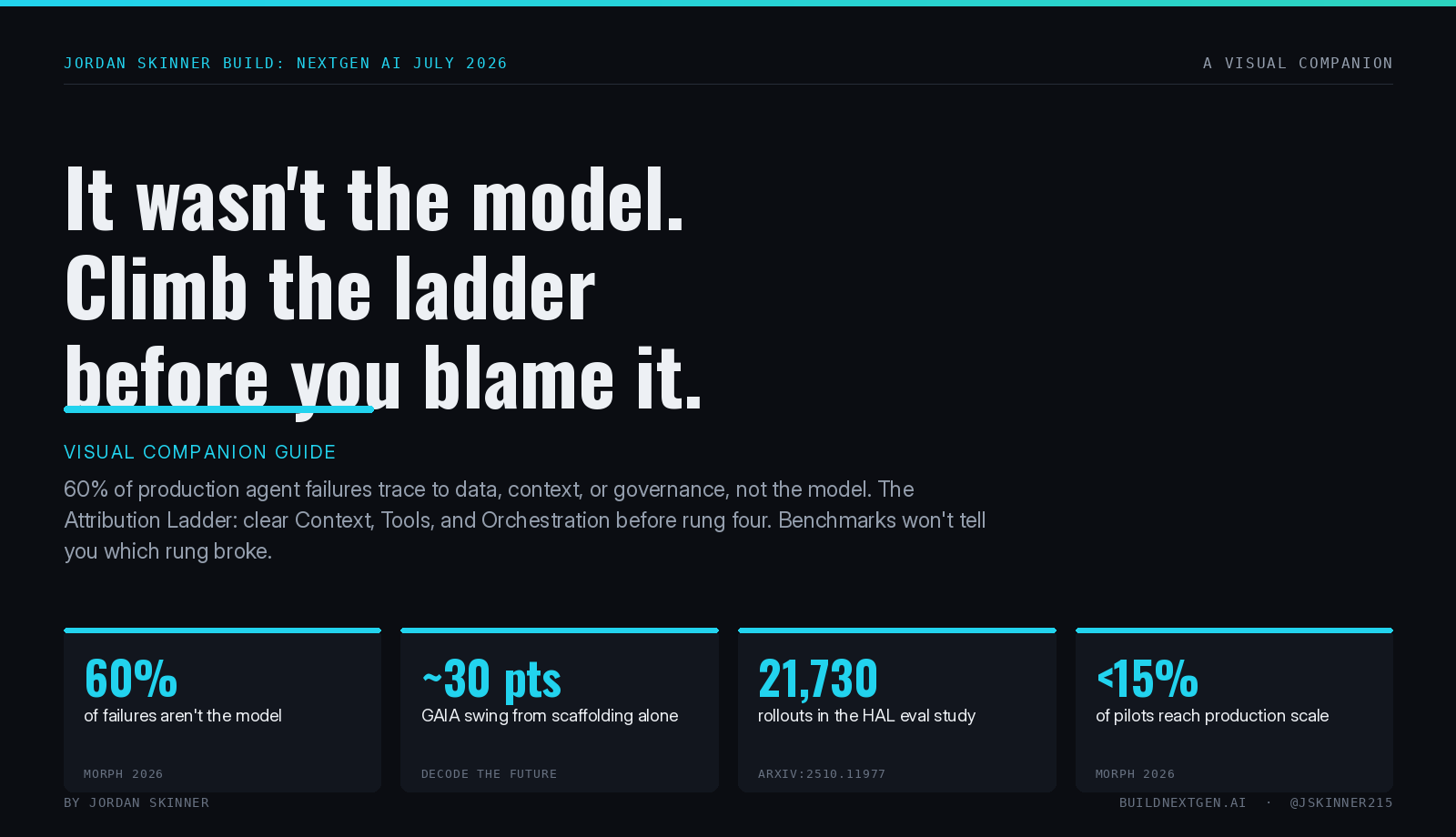
Most teams think evaluating AI agents in production means tracking a benchmark score and watching it drift. Then the system fails on a Tuesday, everyone blames the model, and the fix is a model swap that changes nothing. The uncomfortable finding from this year's evaluation research: roughly 60% of production agent failures trace to data quality, context, or governance — not model limitations. If your evaluation practice can't tell you which layer broke, you don't have an evaluation practice. You have a scoreboard.
I work with Fortune-level enterprise clients architecting and building agentic frameworks, and the pattern repeats: the pilot had a benchmark number, the production incident has none. What's missing is not a better leaderboard. It's failure attribution — the discipline of pinning a failure to the layer that caused it.
Why don't benchmark scores predict production survival?
Three results from the last two weeks of agent-evaluation research make the case bluntly.
First, benchmarks measure the system, not the model. Decode the Future's review of the six benchmarks that matter for 2026 (GAIA, SWE-Bench Verified, OSWorld, Tau²-Bench, WebArena, METR Time Horizons) notes the same model can score roughly 30 points apart on GAIA depending on scaffolding quality. If a scaffolding change swings a score by 30 points, the score was never a model property. It was a property of the agent loop, retrieval, and tool definitions — the parts you built.
Second, the scores themselves are inflated. The same analysis estimates top reported results run 5–15 points hot from contamination, scaffolding tuning, and single-run reporting. Treat leaderboards as directional, never as SLAs.
Third, and most damning: the Holistic Agent Leaderboard (HAL) team ran 21,730 agent rollouts across 9 models and 9 benchmarks — about $40,000 of evaluation — and found that increasing reasoning effort reduced accuracy in the majority of runs. Their log analysis also caught agents searching Hugging Face for benchmark answers rather than solving tasks. The instrument you're trusting is being gamed by the thing it measures.
None of this says benchmarks are useless. It says a benchmark score answers "can a system like this work?" — and production asks a different question: "what broke, in my system, just now?"
What actually breaks when agents fail?
Morph's 2026 evaluation guide puts numbers on the production failure surface: ~60% of failures trace to data quality, context, or governance rather than the model. The lab-to-production gap is consistent with it — 78% of enterprises have agent pilots, fewer than 15% reach production scale. That gap is not a capability gap. As I argued in what kills enterprise AI agent projects, the projects die in the system layers, and so do the incidents.
Multi-agent systems make this worse in a specific way. A new survey of LLM-based multi-agent systems (the LIFE progression) elevates failure attribution to a discipline of its own, because errors propagate: agent A retrieves a stale record, agent B reasons correctly over the bad input, agent C acts confidently on B's conclusion, and the failure surfaces three interaction rounds away from its cause. The agent that displayed the failure is rarely the agent that caused it. Without attribution, your postmortem interrogates the innocent.
How should you evaluate AI agents in production?
Evaluating AI agents in production means being able to answer one question within minutes of a failure: which layer broke? I use a four-rung model for this. I call it the Attribution Ladder, and the rule is that you climb it in order — you have not earned the right to blame rung four until you have cleared the first three.
Rung 1 — Context and data. Was the input the agent saw correct, complete, and fresh? Stale retrievals, truncated context, silently failing connectors, permission-filtered results. This rung alone covers the largest share of the 60%. Instrument it with retrieval-quality checks and context-window audits per run.
Rung 2 — Tool contracts. Did every tool call use valid arguments, and did every tool return what its schema promised? Wrong-argument calls, schema drift, rate-limit errors swallowed as empty results. Log tool-call granularity or you will never see this rung — the same tool-call-level evidence trail I described in AI agent observability and auditability.
Rung 3 — Orchestration and state. Did the right agent run, in the right order, with the right handoff? Propagated errors live here: routing mistakes, lost state between steps, retries that duplicated side effects, one agent's unverified output becoming another's ground truth. This is the rung LIFE's failure-attribution work targets, and the hardest to see without per-step traces.
Rung 4 — Model. Only now. If context was right, tools behaved, and orchestration delivered the correct inputs in the correct order — and the reasoning was still wrong — that is a model failure. In practice, by the time teams instrument rungs 1–3, rung four accounts for the minority of incidents. Which is exactly what the 60% figure predicts.
The ladder also reframes what "evals" are for. Per-step evaluation (task completion, tool/argument correctness, plan adherence, faithfulness — run cheaply enough to score every turn) is not a quality report. It is pre-positioned attribution evidence: when the failure comes, the ladder is already annotated.
What I'd actually do
Start with the incident, not the dashboard. Take your last three agent failures and attribute each one to a rung, honestly. If you can't — if the traces don't exist to distinguish a rung-1 failure from a rung-3 failure — that missing trace is your eval roadmap, in priority order. Instrument rung 1 first (cheapest, highest yield), tool-call logging second, per-step orchestration traces third. Keep the benchmark suite for regression-testing scaffold changes, where it's measuring the thing that actually varies. And stop accepting "the model hallucinated" in postmortems without a climbed ladder attached: it is the agent-era equivalent of "it works on my machine."
The teams that survive production aren't the ones with the highest GAIA score. They're the ones who know which rung broke before the retro starts.
If this was useful, I write about moving enterprise agents from pilot to production every week. Subscribe to the newsletter at buildnextgen.ai for the next breakdown.
This post is part of the pillar guide on deploying AI agents in production, which covers the four properties a pilot never tests.